This post stems from a conversation I had today with a young man attending the university Jason and I work at. After going through the usual Tanzanian greetings and finding out where I was from, he proceeded to ask me a rather difficult and uncomfortable question: "Where does all the money America gives to Tanzania go?" he asked. "We are still crying. The people never see it." He told me to go tell the American embassy that the money they give to Tanzania is going to the wrong people. "There are people all over Tanzania who do not know how to end their day" he said. "Their crying is not heard."
"That is why we are here," I explained. "We have been sent to listen. The Peace Corps sends volunteers all over Tanzania to work alongside Tanzanians in villages and towns. We help Tanzanians connect with the right people so that they do not have to cry anymore."
A smile widened the young man's face. "This is good," he said. "You will learn from Tanzanians and Tanzanians will learn from Americans."
And this is what it is all about. Listening. Sharing. Learning. What we are doing here seems small and insignificant, and the work here is harder than I ever could have imagined, but it is good. We hear the cry of our small little community. God hears their cry. And together, us and God, we make a terrific trio.
Peace,
Heather
Friday, October 25, 2013

Wednesday, October 23, 2013
Tukuyu
One fine weekend in October Jason and I visited our friend Beth when we had time off from work due to the Tanzanian national holiday, Nyrere Day (celebrating Tanzania’s founding father). Beth lives near the hopping little town of Tukuyu and is surrounded by lush mountains that you can climb and tea fields that you can meander through. We did both on our visit. I’ll let the pictures tell the rest of the story.

This is on the trail on the way to the top of Ngozi Crater, which is not too steep at this point in the journey. Ngozi Crater holds a deep blue lake which locals spin magical tales about. You can see little banana trees growing around us. Full grown banana trees have leaves as tall as Jason! On our hike back down the mountain, we saw monkeys swinging in the tall trees that guard the path on the crater.

Tanzania’s Crater Lake, a nice 2629 meters high and well worth the scramble to the crater rim. We ate lunch on the rim and enjoyed the rumble of thunder from an approaching storm that surrounded us.

Beth (in the pink shirt) and Rachel (in purple) and I scrambled/down-climbed the steep sides of the crater in an attempt to reach the lake. Roots from sturdy trees served as our climbing ropes in some cases. About halfway down the crater wall to the lake, I chickened out and returned to the rim.

Jason and I hung out on the rim while our friends took a swim in the crater lake.

In the tea fields near Beth’s school! The tea plantations stretch as far as the eye can see over verdant rolling hills.
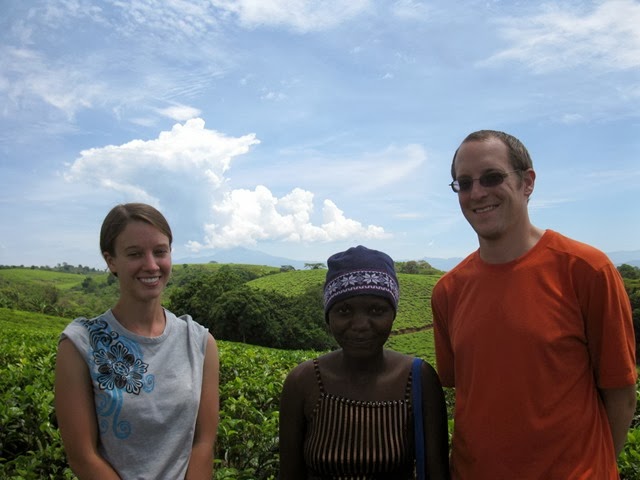
Beth, Eunice, and Jason. Eunice attends college in Mbeya and over the weekend she gave us a tour of the tea fields. She has a very bubbly personality and is very patient in teaching Kiswalil. She is also very generous.
Until our next adventure!
Heather

This is on the trail on the way to the top of Ngozi Crater, which is not too steep at this point in the journey. Ngozi Crater holds a deep blue lake which locals spin magical tales about. You can see little banana trees growing around us. Full grown banana trees have leaves as tall as Jason! On our hike back down the mountain, we saw monkeys swinging in the tall trees that guard the path on the crater.

Tanzania’s Crater Lake, a nice 2629 meters high and well worth the scramble to the crater rim. We ate lunch on the rim and enjoyed the rumble of thunder from an approaching storm that surrounded us.

Beth (in the pink shirt) and Rachel (in purple) and I scrambled/down-climbed the steep sides of the crater in an attempt to reach the lake. Roots from sturdy trees served as our climbing ropes in some cases. About halfway down the crater wall to the lake, I chickened out and returned to the rim.

Jason and I hung out on the rim while our friends took a swim in the crater lake.

In the tea fields near Beth’s school! The tea plantations stretch as far as the eye can see over verdant rolling hills.

Beth, Eunice, and Jason. Eunice attends college in Mbeya and over the weekend she gave us a tour of the tea fields. She has a very bubbly personality and is very patient in teaching Kiswalil. She is also very generous.
Until our next adventure!
Heather
Sunday, September 29, 2013
Homestay Songs
Here are two recordings we made of our host family singing before going to bed. This post uses HTML 5 which may not work for everyone, so I included a few download links as well. Please post a comment or e-mail me if you are having issues.
When the storms of life are raging (download):
How great thou art (download):
When the storms of life are raging (download):
How great thou art (download):
Friday, September 27, 2013
Fish out of Water
As funny as it may sound, before I came to Tanzania I would not have been able to put into words what defines American culture (I could, however, describe to you a bacterial culture). I guess I never gave my own culture much thought. I grew up in it, I lived in it, and I knew what was expected of me and how to behave. Now I find myself in Tanzania-and making mistakes, like not bowing to let the little children touch my head when they greet me. According to the experts from our Peace Corps training, being aware of your own culture and being aware of your own limitations are the top two qualities necessary for living and working in another culture. Seeing and experiencing a different culture has made me more aware of my American culture as I learn about my new culture.
One of the striking differences between American and Tanzanian culture is independence/community. Americans are very independent. We like to figure out solutions to problems on our own with minimal intervention from others. Here in Tanzania, however, you rely on your community much more heavily. For example, today Jason and I took a long walk into the village situated along the main highway. This village has more shops than the little village located just outside of the University grounds. We were looking to buy some mahindi ya bisi (popcorn!) as well as some siage ya karanga (peanut butter!). While searching we ran into a worker at the University who has been helping us with repairs around our apartment. Our American mindset would be to fix our broken cooker ourselves, but here in Tanzania we are learning there is a great need for community support. We never would have found a proper electrician without the aid of our friend. Today while talking we mentioned we would like some little stools made. Our friend immediately offered to talk to the carpenter who he uses and get the stools made for us. My American reaction is to not have our friend handle the making of the stools for us, as I would like to have a say in how our stools are made. We see the world through our culture-colored lenses and I am learning to adjust mine.
Another difference between American and Tanzanian culture is in the way each culture handles greetings and goodbyes. In America, we are casual with greeting each other (Hey! What's up?) and we spend time saying goodbye to each other and wrapping up conversations. In Tanzania, greetings are elaborate. We are asked "Habari za leo?" (what is the news of the day?), "Habari za nyumbani?" (what is the news of home), Habari za sokoni? (how was the market?). Because we are teachers, school children will often say "Shikamoo" to us, which is a greeting of respect meaning literally "I hold your feet." While greeting each other, you often shake hands and continue to hold hands for what feels like a very long time to this American. While we are on the topic of holding hands, it is perfectly normal to see two males or two females walking and talking and holding hands, but a male and a female should not hold hands in public (scandalous!). Tanzanian goodbyes are brief. In fact, if you are having a phone conversation, there may be no goodbye. Tanzanians just hang up when they feel like the conversation has come to an end. Jason and I have not mastered how to discern when the end is yet.
As Americans, we value privacy. We enjoy alone time, especially when sick. If you come to Tanzania, you may feel like Tanzanians are nosy, but their inquisitiveness is actually a part of their culture and how they build relationships. For example, when meeting someone for the first time, you may be asked if you are married, if you have children, and what your religion is. In America, these are not the usual questions you ask after asking a person's name. Another example is when Americans are sick, they like to be alone and rest. Tanzanians want to be constantly checked on to make sure they are alright.
Lastly, I would like to share with you how Tanzanians view Americans. Some of these attributes may come as a shock, while others may make you proud. I know that listening to Tanzanians describe Americans was enlightening to me, so I hope you find the following list interesting and challenging:
One of the striking differences between American and Tanzanian culture is independence/community. Americans are very independent. We like to figure out solutions to problems on our own with minimal intervention from others. Here in Tanzania, however, you rely on your community much more heavily. For example, today Jason and I took a long walk into the village situated along the main highway. This village has more shops than the little village located just outside of the University grounds. We were looking to buy some mahindi ya bisi (popcorn!) as well as some siage ya karanga (peanut butter!). While searching we ran into a worker at the University who has been helping us with repairs around our apartment. Our American mindset would be to fix our broken cooker ourselves, but here in Tanzania we are learning there is a great need for community support. We never would have found a proper electrician without the aid of our friend. Today while talking we mentioned we would like some little stools made. Our friend immediately offered to talk to the carpenter who he uses and get the stools made for us. My American reaction is to not have our friend handle the making of the stools for us, as I would like to have a say in how our stools are made. We see the world through our culture-colored lenses and I am learning to adjust mine.
Another difference between American and Tanzanian culture is in the way each culture handles greetings and goodbyes. In America, we are casual with greeting each other (Hey! What's up?) and we spend time saying goodbye to each other and wrapping up conversations. In Tanzania, greetings are elaborate. We are asked "Habari za leo?" (what is the news of the day?), "Habari za nyumbani?" (what is the news of home), Habari za sokoni? (how was the market?). Because we are teachers, school children will often say "Shikamoo" to us, which is a greeting of respect meaning literally "I hold your feet." While greeting each other, you often shake hands and continue to hold hands for what feels like a very long time to this American. While we are on the topic of holding hands, it is perfectly normal to see two males or two females walking and talking and holding hands, but a male and a female should not hold hands in public (scandalous!). Tanzanian goodbyes are brief. In fact, if you are having a phone conversation, there may be no goodbye. Tanzanians just hang up when they feel like the conversation has come to an end. Jason and I have not mastered how to discern when the end is yet.
As Americans, we value privacy. We enjoy alone time, especially when sick. If you come to Tanzania, you may feel like Tanzanians are nosy, but their inquisitiveness is actually a part of their culture and how they build relationships. For example, when meeting someone for the first time, you may be asked if you are married, if you have children, and what your religion is. In America, these are not the usual questions you ask after asking a person's name. Another example is when Americans are sick, they like to be alone and rest. Tanzanians want to be constantly checked on to make sure they are alright.
Lastly, I would like to share with you how Tanzanians view Americans. Some of these attributes may come as a shock, while others may make you proud. I know that listening to Tanzanians describe Americans was enlightening to me, so I hope you find the following list interesting and challenging:
- Not tolerant
- Punctual
- Hard-working
- Direct
- Frown upon corporal punishment
- Anxious to know what we do not know
- Risk takers
- Self-centered
- Like space and privacy
- Appreciate nature
- Gender sensitive
- Like animals
- Like to cry/emotional
- Concerned about human rights and democracy
Wednesday, September 18, 2013
A Place to Call Home
Site Announcement. Those two words create a spark of excitement that spreads like a wildfire among Peace Corps trainees. Every trainee waits for this day-the day they find out where they will be spending the next two years of their lives living and working alongside Tanzanians. The Peace Corps makes site announcement very dramatic. The staff bring out a map with each trainee's picture covered by a post-it note and linked to a region by a string. Each person is revealed one at a time. People bounded up to the board, excited to hear more details about their site. My name (and thus Jason's too) was called as a picture was revealed linked to the region of Mbeya! Mbeya is a region located in the southwestern corner of Tanzania. We were told that Mbeya is a lush, mountainous region full of tea plantations and banana trees. Sign us up! After learning about our region we were informed that we would be living near the city of Mbeya and teaching at the Mbeya University of Science and Technology (MUST)! Jason was assigned to teach ICT subjects (Information and Communication Technology) and I was assigned to teach Biology.
Three days later we found ourselves on a bus headed from Korogwe to Mbeya via Iringa. A word about transportation in Tanzania. The roads, while mostly paved, are rough. The bus does not stop very often, which means you should not drink water while traveling. If you do, you might have to "chimba dawa" (literally meaning "to take medicine") which entails stopping the bus to squat on the side of the road. When the bus does make official stops, you are bombarded by vendors selling soda, fruits, and other snacks. If you did not buy any from the vendors who push their wares through your window don't worry, your neighbors on the bus will notice and share food with you. There is no air conditioning operating on the bus, which made for a warm ride. Buses do not often arrive on time. We found ourselves waiting at the bus stand for two hours wondering if the bus was still coming. All these things make traveling in Tanzania an adventure. If you approach bus travel in Tanzania with the mindset that life is about the journey, and not the destination, you will be just fine. That, and bring your iPod. You are going to need it.
Once in Mbeya we spent some time with current volunteers. They spoiled us. They made us homemade pizza for dinner the night we arrived and homemade cinnamon rolls the next morning. Then it was off to our site! After a short dala dala (mini-bus) ride, we hailed a taxi to travel the last stretch of dirt road and arrived at the doors to the university. We then waited quite some time to see the acting deputy head of the school. In fact, much of our time at site visit was spent waiting-karibu (welcome to) Tanzania! We toured the university during our stay, Jason met some of his fellow teachers in the ICT department, and we learned what we will be teaching! Jason will teach Electrical Fundamentals and Introduction to Software Engineering and I will teach Applied Biology I and II (basically Microbiology and Molecular Biology/Genetics) in the Laboratory Sciences department. We are very excited to begin working with our fellow teachers at MUST.
After spending three days at our site we returned to Korogwe for some final training and our final exams (which we both passed :) ). On September 12th we officially swore in as Peace Corps Volunteers. Swearing-in was quite the event as it was held at the US ambassador's residence in Dar es Salaam. Speeches were given, all of us new volunteers sang a song, and there was food-very fancy food. The Tanzanian media was present, so we were on the news! We spent most of the 13th (14 hours!) on a bus from Dar es Salaam to Mbeya. Praise the Lord that we were on the nicest bus we have ever traveled in while in Tanzania, it was only four seats wide instead of the usual five. We have been living in our apartment for a few days now. The place needs cleaning, but once we tidy up it will be very nice! We have electricity (it seems to go out every night-it's funny as we live right next to the girl's dormitory and they all scream when the lights go out), running water three times per day (morning, noon, and evening), two balconies, a big living room/dining room, kitchen with attached pantry, two bedrooms, a shower room, and a western style toilet (oh yeah!). Pictures will be forth coming once we settle in. Right now we are busy cleaning and trying to figure out where we can buy all the things we need (like flour...unga wa ngano uko wapi?) After next week Jason and I will begin to prepare our lessons for the start of school on the 28th of October. Sorry for the long absence from our blog...we have been busy!
Kwa heri!
Heather and Jason
PS-If you would like our address, leave us a comment or send us a note via email. Or Facebook me :) Or, if you know my mom, ask my mom.
Three days later we found ourselves on a bus headed from Korogwe to Mbeya via Iringa. A word about transportation in Tanzania. The roads, while mostly paved, are rough. The bus does not stop very often, which means you should not drink water while traveling. If you do, you might have to "chimba dawa" (literally meaning "to take medicine") which entails stopping the bus to squat on the side of the road. When the bus does make official stops, you are bombarded by vendors selling soda, fruits, and other snacks. If you did not buy any from the vendors who push their wares through your window don't worry, your neighbors on the bus will notice and share food with you. There is no air conditioning operating on the bus, which made for a warm ride. Buses do not often arrive on time. We found ourselves waiting at the bus stand for two hours wondering if the bus was still coming. All these things make traveling in Tanzania an adventure. If you approach bus travel in Tanzania with the mindset that life is about the journey, and not the destination, you will be just fine. That, and bring your iPod. You are going to need it.
Once in Mbeya we spent some time with current volunteers. They spoiled us. They made us homemade pizza for dinner the night we arrived and homemade cinnamon rolls the next morning. Then it was off to our site! After a short dala dala (mini-bus) ride, we hailed a taxi to travel the last stretch of dirt road and arrived at the doors to the university. We then waited quite some time to see the acting deputy head of the school. In fact, much of our time at site visit was spent waiting-karibu (welcome to) Tanzania! We toured the university during our stay, Jason met some of his fellow teachers in the ICT department, and we learned what we will be teaching! Jason will teach Electrical Fundamentals and Introduction to Software Engineering and I will teach Applied Biology I and II (basically Microbiology and Molecular Biology/Genetics) in the Laboratory Sciences department. We are very excited to begin working with our fellow teachers at MUST.
After spending three days at our site we returned to Korogwe for some final training and our final exams (which we both passed :) ). On September 12th we officially swore in as Peace Corps Volunteers. Swearing-in was quite the event as it was held at the US ambassador's residence in Dar es Salaam. Speeches were given, all of us new volunteers sang a song, and there was food-very fancy food. The Tanzanian media was present, so we were on the news! We spent most of the 13th (14 hours!) on a bus from Dar es Salaam to Mbeya. Praise the Lord that we were on the nicest bus we have ever traveled in while in Tanzania, it was only four seats wide instead of the usual five. We have been living in our apartment for a few days now. The place needs cleaning, but once we tidy up it will be very nice! We have electricity (it seems to go out every night-it's funny as we live right next to the girl's dormitory and they all scream when the lights go out), running water three times per day (morning, noon, and evening), two balconies, a big living room/dining room, kitchen with attached pantry, two bedrooms, a shower room, and a western style toilet (oh yeah!). Pictures will be forth coming once we settle in. Right now we are busy cleaning and trying to figure out where we can buy all the things we need (like flour...unga wa ngano uko wapi?) After next week Jason and I will begin to prepare our lessons for the start of school on the 28th of October. Sorry for the long absence from our blog...we have been busy!
Kwa heri!
Heather and Jason
PS-If you would like our address, leave us a comment or send us a note via email. Or Facebook me :) Or, if you know my mom, ask my mom.
 |
| The main tent under which speeches were given-go America! |
 |
| Jason and Me all dressed up for the occasion-I had the dress made in Korogwe! |
 |
| Our Community Based Training (CBT) group-we will miss everyone! |
Wednesday, August 21, 2013
A day in the Life of a PCT
I thought all of our readers would enjoy learning about a typical day for a PCT in Tanzania (although, there really is no typical day).
5:00 am-We hear the Muslim call to prayer and Jason's alarm goes off to help start the charcoal jiko in the morning. Our family heats water to take a morning bucket bath, which I am grateful for. A cold bucket bath would not be pleasant.
6:00 am-Heather wakes up to take her bucket bath after Jason. We bathe in our indoor choo, which is tiled. There is a nice line to hang up all of your clothes and towel on while you bathe. It is just starting to get light at this time of the morning.
6:30 am-We eat breakfast. Breakfast here is chai with bread. Jason and I expanded our breakfast menu by purchasing peanut butter at a local shop. We were even more excited when we brought back jam from Lushoto! After breakfast we finish packing our bags and brush our teeth.
7:00 am-We begin our 30 min walk to school. Jason and I both teach 7:40 am classes most days of the week, so we need to leave early to prepare our classes. On our walk to school we greet many neighborhood children. They often serenade us with a chorus of "how are yous?" and "Wauzungu (meaning white person or foreigner)! "
7:30 am-10:20 am-This time can be chaotic. Sometimes we are teaching, sometimes we are in Kiswahili class. There are three other volunteers in our community-based training group, so more often than not someone is teaching during this time. When we have Kiswahili class, we will often review what we learned the day before and practice our speaking skills.
10:20 am-10:55 am-Chai time! It's the best time of the day, really! We order what we would like for the day from a Mama who cooks at the school. At our school, there is a row of huts lashed together with poles and grass roofs and under each one sits a different Mama who cooks. Our Mama sits in the last hut. Around 9:30 am one of us will go and place an order for chapati (sweet, thick crepes) and maandazi (the Tanzanian doughnut). We take chai in the staff room with the other teachers. We eat our bites and drink sugar with tea. You did not read that wrong. Tanzanians like to put a fair amount of sugar in their tea. It is incredibly sweet.
11:00 am-1:00 pm-Teaching and Kiswahili again. By this time we are moving into new material in our Kiswahili. We all take lots of notes and ask many questions of our language facilitator.
1:00 pm-2:00 pm-Lunch time! This can be less than thrilling. One lunch last week we were given ugali and dagaa (ugali is a stiff cornflour and dagaa are little fishes that were sundried then recooked). Only about half of us ate it and our language facilitator explained to our mama that we do not care for ugali and dagaa. So now we mostly get some variation of rice, beans and meat. We are also getting more spaghetti like dishes. The noodles here are cooked with sugar instead of salt so the first byte plays tricks with your mind. Sometimes, lunch is spectacular. For example, everyone except Jason likes chipsi mayai. Chipsi mayai is fried potato wedges and eggs used to stick them all together. The potatoes are surrounded in fried egg goodness. Heart attack on a plate? Yes, but it is delicious.
2:00 pm-4:00 pm-More Kiswahili. I must say, the Peace Corps language program is excellent. We can converse about our daily activities and our families, and ask questions. And we are only a little over halfway through training.
4:00 pm-We walk home. We are alone on the walk as the students get out of school around 2:00 pm. The walk home is normally hot. We greet many people on our way home. Our favorite people to greet are the kids. We give Tanzanian high fives all around and try to teach them to say "good evening" instead of "good morning." We often get followed all the way home.
4:30 pm-8:00 pm-We are home! Heather will sweep the floor of our room and we will converse about our day with our host family. We will study some Kiswahili and work on lesson plans. Our little sisters will cause general pandemonium, occasionally making it difficult study without retreating to our room. We may help cook dinner. The most common task we are given is to sort through the rice. We have to pick out all the chaff and stones. Heather may iron clothes if laundry is dry. Now, when you think of Heather ironing, think Little House on the Prairie style. We iron with a charcoal-powered iron. You pick hot coals out of the charcoal stove, plop them in the cast-iron iron, and go to town ironing your clothes on the coffee table. Dark falls around 6:45 pm here, so the ironing is usually done by the glow of a solar-powered LED light.
8:00 pm-8:30 pm-We eat dinner! I am always very appreciative of the cooks, as a meal takes around 2-3 hours to prepare. For dinner we normally have things like rice, pilau (dirty or seasoned rice), beans, spinach, beef, oranges, mangoes, cucumbers, and salad called kachumbari made of a tomato, cucumber, and bell pepper. Delicious! We will talk with our host family during and after dinner; they like to ask questions about America and we all enjoy comparing and contrasting American life to Tanzanian life.
9:00 pm-We are heading to bed. Our little sisters follow us outside and we all brush our teeth by the light of our headlamps. We may sing and say prayers with our family before bed. We tell our family goodnight, tuck our mosquito net securely around us, and fall to sleep to the sounds of our village (chickens, radios, laughter, dogs, the call to prayer). Our family stays up later than us. We are still not sure how Tanzanians do as much work as they do on so little sleep.
That's it for our typical day. Our next post will be an exciting one! Later today, we will learn where we will be placed for 2 years. Then on Saturday, we get to make a road trip and spend all next week at our site! Though if we get placed in the southern portion of the country, we may get less than 72 hours there because it takes almost 3 fully days to travel each way.
Baadaye!
Jason and Heather.
5:00 am-We hear the Muslim call to prayer and Jason's alarm goes off to help start the charcoal jiko in the morning. Our family heats water to take a morning bucket bath, which I am grateful for. A cold bucket bath would not be pleasant.
6:00 am-Heather wakes up to take her bucket bath after Jason. We bathe in our indoor choo, which is tiled. There is a nice line to hang up all of your clothes and towel on while you bathe. It is just starting to get light at this time of the morning.
6:30 am-We eat breakfast. Breakfast here is chai with bread. Jason and I expanded our breakfast menu by purchasing peanut butter at a local shop. We were even more excited when we brought back jam from Lushoto! After breakfast we finish packing our bags and brush our teeth.
7:00 am-We begin our 30 min walk to school. Jason and I both teach 7:40 am classes most days of the week, so we need to leave early to prepare our classes. On our walk to school we greet many neighborhood children. They often serenade us with a chorus of "how are yous?" and "Wauzungu (meaning white person or foreigner)! "
7:30 am-10:20 am-This time can be chaotic. Sometimes we are teaching, sometimes we are in Kiswahili class. There are three other volunteers in our community-based training group, so more often than not someone is teaching during this time. When we have Kiswahili class, we will often review what we learned the day before and practice our speaking skills.
10:20 am-10:55 am-Chai time! It's the best time of the day, really! We order what we would like for the day from a Mama who cooks at the school. At our school, there is a row of huts lashed together with poles and grass roofs and under each one sits a different Mama who cooks. Our Mama sits in the last hut. Around 9:30 am one of us will go and place an order for chapati (sweet, thick crepes) and maandazi (the Tanzanian doughnut). We take chai in the staff room with the other teachers. We eat our bites and drink sugar with tea. You did not read that wrong. Tanzanians like to put a fair amount of sugar in their tea. It is incredibly sweet.
11:00 am-1:00 pm-Teaching and Kiswahili again. By this time we are moving into new material in our Kiswahili. We all take lots of notes and ask many questions of our language facilitator.
1:00 pm-2:00 pm-Lunch time! This can be less than thrilling. One lunch last week we were given ugali and dagaa (ugali is a stiff cornflour and dagaa are little fishes that were sundried then recooked). Only about half of us ate it and our language facilitator explained to our mama that we do not care for ugali and dagaa. So now we mostly get some variation of rice, beans and meat. We are also getting more spaghetti like dishes. The noodles here are cooked with sugar instead of salt so the first byte plays tricks with your mind. Sometimes, lunch is spectacular. For example, everyone except Jason likes chipsi mayai. Chipsi mayai is fried potato wedges and eggs used to stick them all together. The potatoes are surrounded in fried egg goodness. Heart attack on a plate? Yes, but it is delicious.
2:00 pm-4:00 pm-More Kiswahili. I must say, the Peace Corps language program is excellent. We can converse about our daily activities and our families, and ask questions. And we are only a little over halfway through training.
4:00 pm-We walk home. We are alone on the walk as the students get out of school around 2:00 pm. The walk home is normally hot. We greet many people on our way home. Our favorite people to greet are the kids. We give Tanzanian high fives all around and try to teach them to say "good evening" instead of "good morning." We often get followed all the way home.
4:30 pm-8:00 pm-We are home! Heather will sweep the floor of our room and we will converse about our day with our host family. We will study some Kiswahili and work on lesson plans. Our little sisters will cause general pandemonium, occasionally making it difficult study without retreating to our room. We may help cook dinner. The most common task we are given is to sort through the rice. We have to pick out all the chaff and stones. Heather may iron clothes if laundry is dry. Now, when you think of Heather ironing, think Little House on the Prairie style. We iron with a charcoal-powered iron. You pick hot coals out of the charcoal stove, plop them in the cast-iron iron, and go to town ironing your clothes on the coffee table. Dark falls around 6:45 pm here, so the ironing is usually done by the glow of a solar-powered LED light.
8:00 pm-8:30 pm-We eat dinner! I am always very appreciative of the cooks, as a meal takes around 2-3 hours to prepare. For dinner we normally have things like rice, pilau (dirty or seasoned rice), beans, spinach, beef, oranges, mangoes, cucumbers, and salad called kachumbari made of a tomato, cucumber, and bell pepper. Delicious! We will talk with our host family during and after dinner; they like to ask questions about America and we all enjoy comparing and contrasting American life to Tanzanian life.
9:00 pm-We are heading to bed. Our little sisters follow us outside and we all brush our teeth by the light of our headlamps. We may sing and say prayers with our family before bed. We tell our family goodnight, tuck our mosquito net securely around us, and fall to sleep to the sounds of our village (chickens, radios, laughter, dogs, the call to prayer). Our family stays up later than us. We are still not sure how Tanzanians do as much work as they do on so little sleep.
That's it for our typical day. Our next post will be an exciting one! Later today, we will learn where we will be placed for 2 years. Then on Saturday, we get to make a road trip and spend all next week at our site! Though if we get placed in the southern portion of the country, we may get less than 72 hours there because it takes almost 3 fully days to travel each way.
Baadaye!
Jason and Heather.
Thursday, August 8, 2013
Lushoto
Tanzania is a beautiful country. We have not seen all of it yet, but what we have seen has been stunning. The town of Lushoto will take your breath away. Literally. With an elevation of 4800 ft, the huddle of homes is tucked away in the Usambara mountains. Our travel from Korogwe to Lushoto took us up a winding mountain road past many waterfalls. We took lunch at Irente Biological Reserve. Lunch was fantastic! Most all of the food is grown locally and sustainably. We ate rye bread with homemade cheeses, homemade jam, cucumbers, tomatoes, and guacamole. We were in American Food Heaven. We most definitely bought some cheese and jam to bring home to share with our host family. Irente is owned by the Lutheran Church, with a portion of the proceeds from lunch going to an orphanage, a school for the blind, and a school for the mentally disabled. You can camp or stay in well-appointed huts at Irente. The Usambaras are known for their great hiking, so Irente would be the perfect place to start your Tanzanian hiking adventure. We hiked 2 km to a viewpoint overlooking the valley below and the sight was spectacular! But the goodness of Lushoto does not stop at Irente. After Irente we headed to Lawns, a guesti in Lushoto. Free wi-fi and cold sodas made these two Peace Corps Trainees very happy. Lawns was a haven of Western Civilization, which was wonderful to visit after a month in Tanzania. I would definitely recommend a visit to Lushoto if you make it to Tanzania. You can soak up the Tanzaian culture in town and still have a hot shower and a Western toilet waiting for you when you retire for the evening. For now, Kwa heri!
 |
| The Usambaras |
 |
| The view from Lushoto-if we live here, will you come visit us? |
 |
| Jason on our hike to the viewpoint |
Subscribe to:
Posts (Atom)